Gartner's 2025 CIO and Technology Executive Survey reveals a sobering reality for the public sector: only 48% of digital initiatives consistently meet or exceed their business outcome targets. This gap rarely stems from a lack of vision or front-end capability. Instead, it is increasingly tied to integration friction; the invisible drag created when high-velocity digital front-ends outpace the legacy backends and inter-agency handoffs that power them.
For the Middle East, particularly in the UAE and Saudi Arabia, this challenge is the byproduct of success. These nations have already leapfrogged global peers in basic digitization, establishing world-class digital identities (UAE Pass, Nafath) and unified service portals. However, as Vision 2030 and the UAE's National Digital Government Strategy move into their next phase, the hurdle is no longer going digital, it is scaling the ecosystem.
The current frontier is the move from fragmented transactions to seamless life events. While portals may look unified, the underlying reality often involves "coordination debt": the accumulated cost of unmanaged handoffs between ministries. To reach the next level of maturity, regional CIOs are moving beyond the risky, disruptive reflex of "rip and replace" modernization. Instead, they are adopting a strategy of non-invasive orchestration, wrapping existing foundational systems in a robust integration layer to extract data and logic without touching the underlying code. This allows for digital-first delivery at the speed of modern platforms while preserving the stability and compliance of the state's core registries.
The Infrastructure of Invisible Government
Building a unified G2C environment requires three distinct architectural shifts; each as much about governance and the operating model as the technology itself.
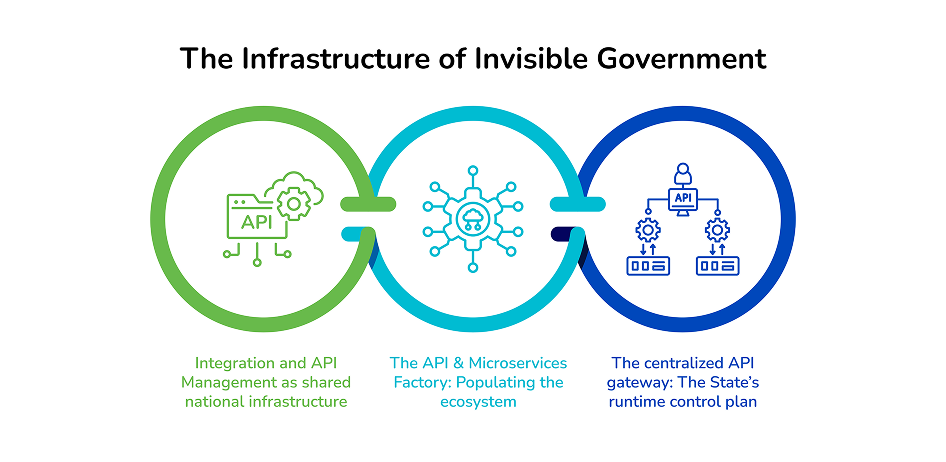
1. Integration and API Management as Shared National Infrastructure
At the heart of a seamless government is a well-defined integration layer, supported by API management and a governed service marketplace. Rather than a collection of isolated websites, this is a governed exchange where digital capabilities, such as Verify Identity, Process Payment, or Check Eligibility, are treated as reusable national assets.
In the federated models of the UAE and Saudi Arabia, digital initiatives often slow down not due to a lack of talent, but due to a lack of discoverability and trust. Within a mature ecosystem, ministries and authorized partners no longer "integrate point-to-point." Instead, they participate in a shared environment where:
- Standards are Embedded: Every asset within the ecosystem is certified for national security and data sovereignty, ensuring that "coordination debt" doesn't accumulate as the system scales.
- Redundancy is Eliminated: Teams can see what already exists before building anew. A capability built by one ministry becomes a building block for the entire ecosystem.
- Innovation is Decentralized: By providing a clear "marketplace" of available services, the government allows municipalities, semi-government entities, and private partners to consume approved capabilities safely, accelerating the delivery of complex life-event journeys.
Forrester Total Economic Impact™ study on Azure API Management - Organizations using modern API management realized benefits of $3.5 million over three years (versus $834,000 in costs), delivering a 315% ROI, with key gains in developer productivity, faster API delivery, and reduced integration overhead.
2. The API & Microservices Factory: Populating the Ecosystem
If the ecosystem defines the "rules of the exchange," the API & Microservices Factory is the industrial engine that populates it. The era of monolithic "super-apps" is giving way to modularity.
By adopting a factory model, CIOs move away from bespoke, one-off integrations. This approach creates a repeatable pipeline that "wraps" legacy systems and transforms their functions into the reusable microservices that the ecosystem demands. This factory model ensures that:
- Speed is Decoupled from Stability: Developers can innovate at the "speed of the citizen" (weeks) while the underlying legacy systems continue to run at the "speed of the record" (years).
- Consistency is Guaranteed: Every service produced by the factory is born "ecosystem-ready," with standardized documentation, security protocols, and monitoring built-in from day one.
3. The Centralized API Gateway: The State’s Runtime Control Plane
While the ecosystem acts as the catalog and the factory as the production line, the API Gateway serves as the runtime control plane. It hides backend complexity from citizens while orchestrating interactions across the various players in the ecosystem in real time.
Beyond routing traffic, the gateway enforces the "Sovereign Ruleset." In the GCC region, where data residency and classification are paramount, the gateway acts as the ultimate enforcer, managing encryption, consent, and policy-based access. Citizens experience a single, "invisible" service, while the government retains absolute control over how data flows between agencies and partners.
The "Human" backend: Where automation actually begins
Many government backends are not just systems; they are people. Despite world-class front-ends, a significant portion of service execution still involves manual review, document validation, and cross-departmental "sign-offs", often mediated through legacy workflows.
This is where the integration and API management layer meets hyper-automation. By integrating workflow orchestration and AI-driven decisioning into the API layer, governments can bridge the gap between modern digital requests and manual legacy processes.
- Standardizing Judgment: Automation allows governments to standardize handoffs and reduce the "5-7 business day" wait times by digitizing the decision path, not just the intake form.
- Humans-in-the-Loop: In this model, APIs expose the data, automation governs the flow, and humans are elevated to a "quality assurance" role, handling complex exceptions rather than routine data entry.
From throughput to outcome: The backend integration value
Most government backends were historically designed to be correct and auditable, but rarely coordinated. In that model, success was measured by throughput: the volume of documents processed, the number of licenses issued, or the speed of an individual transaction.
However, when backend systems are integrated through a shared API and orchestration layer, the nature of government itself changes. Agencies stop optimizing isolated documents and start orchestrating life events.
Consider the birth of a child. In a siloed environment, parents must navigate a maze of interactions: registering the birth with the hospital, applying for a national ID, updating health records, and enrolling for social benefits. Each is a separate "throughput" metric for a different ministry.
In an integrated ecosystem, the hospital's notification acts as a single trigger. Because the backends are orchestrated, a "Birth Event" automatically:
- Generates a National Identity record.
- Updates the family's healthcare eligibility.
- Initiates proactive benefit disbursements.
This transition from IT efficiency to national economic impact is a cornerstone of future growth. According to the Digital Cooperation Organization (DCO) and the World Bank, high-maturity Digital Public Infrastructure (DPI), which prioritizes this type of integrated data exchange, can accelerate a nation's GDP growth by up to 33% by 2030 by drastically reducing friction for businesses and citizens.
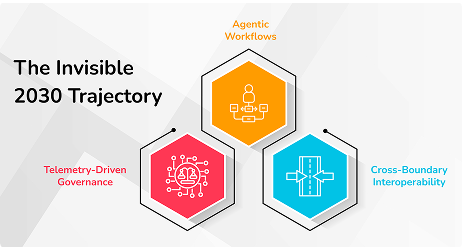
The Invisible 2030 trajectory
The first phase of the Saudi and UAE digital journeys was about access: establishing digital identity, payments, and national platforms. The next phase is about orchestration at scale. As initiatives expand across diverse ministries and private-sector partners, the challenge is ensuring that policies, data, and services move as one.
This leads to a form of "invisible government": highly observable to leadership via real-time telemetry, but entirely frictionless for the citizen. In this future, a governed integration layer, where services are discoverable, reusable, and enforceable at runtime, enables three core capabilities:
- Agentic Workflows: Policy logic is executed dynamically across APIs, allowing the state to anticipate citizen needs (e.g., proactive license renewals or benefit eligibility) rather than waiting for an application.
- Telemetry-Driven Governance: Integration data reveals coordination risks and system bottlenecks before they become service failures.
- Cross-Boundary Interoperability: Ministries retain their autonomy but operate through shared digital contracts and enforced standards.
Three strategic mandates for public-sector CIOs
To deliver on this vision, the role of the CIO must shift from "system builder" to "ecosystem curator." This requires three fundamental shifts in priority:
-
1. Treat integration as sovereign infrastructure
Elevate API management and the governed API marketplace to the same governance tier as national identity and cloud platforms. This is no longer a project-level IT task; it is a sovereign capability that requires an executive mandate and long-term funding to ensure the "rails" of the state remain modern and secure.
-
2. Shift metrics from "Digitization" to "Orchestration"
Stop measuring success by how many forms are now online. Instead, use integration telemetry to track the health of the ecosystem: cross-agency handoff latency, exception rates in "human" backends, and the reuse rate of existing APIs. This gives leadership a concrete way to see, and reduce, coordination debt.
-
3. Use the ecosystem to scale without centralization
In the federated models of the GCC, forcing every ministry into a single central system is impossible. Instead, use the governed API marketplace to enforce standards through digital contracts and runtime controls. This allows individual agencies to innovate at their own pace while ensuring they remain "pluggable" into the national whole.
Conclusion
Digital government at scale is no longer about the number of services available on a portal. It is about how reliably those services can be shared, composed, and delivered across an expanding landscape of partners.
Legacy complexity is an internal reality, but designing systems that surface that complexity to the citizen is a choice.
By treating the governed API marketplace, API management, and the microservices factory as foundational infrastructure, governments can move beyond digitized transactions and deliver on the true promise of Vision 2030: a state that works as a coherent, predictable, and invisible system.
About the author

|
Seona ShajiSenior Content Strategist,Torry Harris Integration Solutions |