


Saudi Arabia is currently home to one of the most deliberate experiments in large-scale digital transformation globally. From the rapid expansion of giga-projects such as NEOM to the seamless, paperless interfaces of government platforms, the pace at which digital capability has been built is unusually high by global standards.
By 2026, IT spending in the MENA region is forecasted to reach $169 billion, with software investment growing by nearly 14% as organizations accelerate their adoption of Generative AI, as projected by Gartner in its latest regional outlook. Under Vision 2030, Saudi Arabia has not only embraced digital ambition, it has achieved digital scale.
The question now is what comes next.
Because at scale, the nature of the challenge changes. When an economy moves from isolated digital pilots to national-scale digital systems, the primary challenge is no longer the acquisition of technology, it is the orchestration of it. Saudi Arabia has successfully built world-class digital capabilities. The next phase of economic value will be defined by how effectively they are connected.
The Value Gap: A Structural Disconnect
The financial stakes are significant. Saudi Arabia’s digital transformation market is estimated at over $55 billion in 2025 and is projected to exceed $90 billion by 2030, according to analysis by Mordor Intelligence, driven by Vision 2030 programs, hyperscale cloud investments, and near-complete digitisation of government services.
However, beneath this momentum lies a structural disconnect. A landmark report on the GCC’s state of AI, published by McKinsey & Company, found that while 84% of organizations have adopted AI in at least one function, only 11% are generating measurable financial returns.
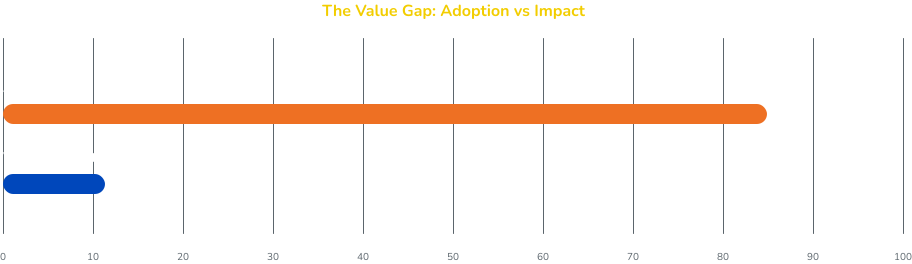
This is the region’s “value gap.” It suggests that while innovation is advancing rapidly, it is not yet fully connected to the broader economy. This isn’t a failure of vision; it is a symptom of fragmented architecture. In the rush to adopt the new, many organizations have left existing systems in a state of isolated excellence; capable within domains, but not fully integrated into the wider ecosystem.
The Architecture of Isolation
This isolation is not accidental; it is an architectural legacy. Across sectors like banking, healthcare, and government, organizations are operating on back-ends that were not originally designed for interoperability at scale.
Industry analyses consistently highlight legacy architecture as a primary execution challenge in digital transformation, where custom-built systems often remain incompatible with modern, modular platforms. When advanced AI capabilities are layered onto fragmented environments, organizations frequently face challenges in customizing models due to inconsistent and siloed data.
You cannot automate workflows that span systems if the underlying data cannot move between them. At smaller scales, these frictions are manageable. At scale, they become a practical limit on ROI.
The Integration Tax on Value Creation
In a platform-led economy, connectivity is not a technical detail, it is the strategy. Yet, integration is frequently treated as a secondary task, addressed after core platforms are launched.
This creates a material constraint on value creation. Industry benchmarks show that organizations today operate hundreds of applications, yet only a fraction are meaningfully connected. This fragmentation acts as a hidden tax on every new digital initiative. Companies with strong integration consistently achieve significantly higher returns from AI investments compared to those operating in disconnected environments.
Firms embedding AI into innovation strategies show the greatest upside, with potential to triple market cap Deloitte Insights compared to those focused only on modernisation.
In Saudi Arabia, this challenge carries greater significance. Economic activity is increasingly structured through government-led digital platforms: from procurement ecosystems to sector-wide marketplaces that aggregate demand at national scale.
If these systems cannot communicate seamlessly with financial institutions, suppliers, and logistics networks, the scale that has been built remains underutilised.
The Agentic Shift: From Analysis to Action
The requirement for connectivity is about to intensify. The emergence of agentic AI introduces systems that move beyond analysis into execution; interacting across applications, triggering workflows, and operating within broader ecosystems.
Consider a scenario where a business registration automatically initiates credit evaluation, regulatory approvals, and logistics enablement across multiple institutions. This level of orchestration depends not only on advanced models, but on the ability of systems to interact reliably across boundaries.
Currently, only 23% of organizations globally are scaling agentic AI capabilities, as highlighted in recent research by McKinsey & Company. The transition from analytical tools to action-based systems requires digital infrastructure that many organizations are still in the process of building.
The implication is clear: future value will depend less on isolated intelligence and more on coordinated execution.
Making the System Work: Integration as Strategy
What this shift reveals in practice is that integration is no longer a technical layer, it is the mechanism through which value is created. Progress is now less about adding new components and more about ensuring coherence across existing ones.

In Saudi Arabia, some of the most important marketplaces are not private platforms, they are government-led systems that aggregate demand at scale. Their effectiveness depends on how well they connect participants across the ecosystem.
This requires two fundamental shifts:
Interoperability as a core design principle
Moving away from bespoke, isolated systems toward architectures that are designed to connect and scale across environments.
Ecosystem thinking
Recognizing that organizations no longer operate in isolation, but as part of interconnected networks where value is co-created.
PwC’s 27th Annual CEO Survey found that 48% of Middle East CEOs believe their companies will not be viable in a decade without significant evolution. That evolution is not another software purchase; it is a shift in how systems are designed and connected.
Over the past two decades, our work at Torry Harris across the Middle East has consistently shown that the most resilient organizations are those that treat integration as a competitive advantage. The goal is not to replace a legacy stack overnight, but to implement an orchestration layer that connects disparate systems, participants, and workflows into a unified whole. Whether enabling a Government-to-Business (G2B) marketplace supporting cross-sector ecosystems, the objective remains the same: allowing value to flow with minimal friction.
The Bottom Line
Saudi Arabia’s rapid digital expansion has set a global benchmark for what can be achieved with clear vision and decisive investment.
Closing the gap between AI adoption and measurable impact requires a fundamental shift in architectural thinking. Integration is no longer a technical support function; it is the strategic layer that dictates the velocity of the entire digital economy. For the leaders of the next decade, the primary objective will be ensuring that the Kingdom’s diverse digital assets function not as a collection of parts, but as a unified, high-performance system.
Frequently asked questions
While AI adoption across Saudi Arabia is high, many organisations are still operating on fragmented systems. As a result, AI initiatives often remain confined to isolated use cases rather than driving end-to-end business impact. The gap between adoption and value is largely due to a lack of connectivity across systems, data, and workflows, which limits the ability to scale AI outcomes across the enterprise.
Poor integration creates silos between systems, making it difficult for data to move seamlessly across the organisation. This limits the effectiveness of AI models, which rely on consistent, high-quality data to deliver meaningful insights. In fragmented environments, organisations often face delays, increased manual intervention, and reduced ROI from digital investments.
Government-led marketplaces act as aggregation platforms that bring together suppliers, enterprises, and service providers at scale. In economies like Saudi Arabia, these platforms enable more efficient procurement, improve SME participation, and streamline interactions across sectors. Their effectiveness, however, depends on how well they are integrated with financial systems, logistics networks, and regulatory frameworks.
AI return on investment (ROI) varies widely across organisations, as many initiatives are still in early or experimental stages. Current estimates suggest average ROI ranges between 16% and 31%, with value often realised over time rather than immediately.
The most consistent gains are seen in areas such as productivity, quality of work, and operational efficiency, with some specialised functions reporting cost reductions of up to 50–70%. However, achieving sustained ROI depends on how effectively AI is integrated into broader systems and workflows.
Proving AI ROI requires focusing on outcomes that can be clearly measured. This typically includes efficiency gains, cost reductions, and improvements in productivity or service quality.
Many organisations begin by validating ROI at a smaller scale — using measurable improvements to build confidence and justify further investment. These early gains can then support broader deployment and help establish a stronger business case for scaling AI initiatives across the enterprise.
Closing the value gap requires a shift from isolated digital initiatives to integrated, ecosystem-driven models. Organisations need to focus on improving system interoperability, enabling seamless data flow, and building orchestration layers that connect workflows across the enterprise. By doing so, they can move from experimentation to scalable, value-generating AI deployments.
About the author

|
Seona ShajiSenior Content Strategist,Torry Harris Integration Solutions |

