
The digital landscape is undergoing a fundamental shift. We are moving from the era of API 1.0 where the goal was simply to make APIs available to API 2.0, where the focus is on using APIs to orchestrate complex, multi-tiered, connected ecosystems.
By shifting the focus from mere technical exposure to building governed, strategic API management approaches, organizations are no longer just "connecting systems"; they are unlocking new revenue streams and creating defensible competitive differentiation.
For the C-Suite, the API Economy has often felt like a technical promise that hasn't fully realized its commercial potential. To move forward, leaders must address five critical pain points that currently stall digital growth:
- Stalled Digital Growth: Many enterprises have built thousands of APIs but have failed to translate them into direct or indirect revenue.
- Fragmented Ecosystems: Disconnected platforms and disparate partners duplicate integration efforts, leading to a "spaghetti" architecture that slows down market reach.
- Operational Silos: APIs developed in silos lack standardized governance or analytics, leaving leadership blind to which assets are actually driving value.
- Lost Monetization Opportunities: High-value data and services are often shared freely or buried in legacy systems instead of being productized for external consumption.
- The Pressure for Speed: CXOs are caught in a constant tug-of-war; balancing the need for lightning-fast partner onboarding with the rigid requirements of control and compliance.
From exposure to orchestration: The 2.0 transformation
API Economy 2.0 takes APIs beyond simple integration interfaces. It facilitates the creation of a digital ecosystem where partners, customers, and even competitors can co-generate value.
The objective is to selectively expose governed business capabilities and data abstractions to drive innovation. In this model, value is driven not just by consumers, but by co-creators and market enablers. Success is no longer measured by "uptime" alone, but by ecosystem growth rates, third-party partnership revenue, and the speed of digital transaction cycles.

The pillars of an API 2.0 security framework
- Zero Trust API Access: Implementing frameworks like Forrester’s Zero Trust eXtended (ZTX). This ensures that every API call whether internal or external is continuously verified, authenticated, and authorized based on context.
- Identity and Token Standards: Strict adherence to OAuth2 and OpenID Connect (OIDC), combined with robust encryption, ensures that data remains secure even when passing through multiple partner nodes.
- Continuous Threat Detection & Bot Protection: Using AI-driven monitoring to identify anomalous traffic patterns, preventing brute-force attacks, scraping, and credential abuse in real-time.
- Global Compliance Automation: To scale globally, the ecosystem must automatically enforce standards such as GDPR (Privacy), PSD2 (Banking), HIPAA (Healthcare), and PCI DSS (Payments). This automation allows for "compliance by design," enabling fast onboarding without legal risk.
5 models for monetizing ecosystem connectivity
Enterprises are evolving beyond traditional pay-per-call API models. By diversifying how they capture value, they can turn their infrastructure into a profit center.
| Monetization model | Description | Strategic value | Example |
|---|---|---|---|
| Usage-based | Pay-per-call, bandwidth-based, or volume-tiered pricing. | Ideal for utility-based APIs where costs scale with usage. | Google Maps: Charges per API request based on volume. |
| Capability-based | Charging for premium, niche functions (e.g., fraud detection, ID verification). | Productizes high-value, specialized workflows as standalone services. | Stripe Radar: Offers internal fraud/risk tools as a premium API. |
| Partner Revenue Share | Joint value models where the enterprise takes a cut of partner revenue. | Lowers direct development costs while expanding platform reach. | Salesforce AppExchange: Thousands of apps expand the platform via revenue shares. |
| Subscription-based | Tiered SLAs, enterprise access plans, and predictable monthly fees. | Creates "sticky" revenue with guaranteed levels of support and uptime. | Financial Data APIs: Offering different tiers for "Real-time" vs "Delayed" data access. |
| Marketplace & Certification | Charging listing fees, certification fees, and transaction commissions. | Establishes a curated, high-quality digital storefront for third-party services. | Siemens: Enables startups to build and sell services on their industrial IoT platforms. |
The growth flywheel
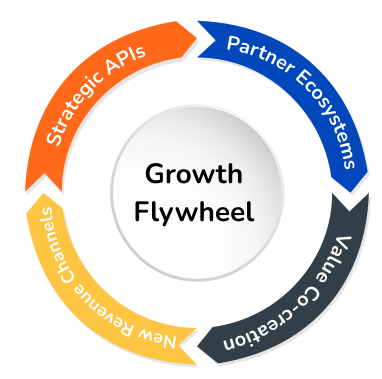
The success of API Economy 2.0 is defined by a "flywheel effect." Each element of the strategy amplifies the others, creating a self-reinforcing cycle of growth.
- Strategic APIs: High-quality, governed APIs attract developers and partners.
- Partner Ecosystems: A growing network of partners increases the utility of the platform.
- Value Co-creation: Partners build new services on your APIs, creating solutions you didn't have to build yourself.
- New Revenue Channels: Increased usage and new services lead to more monetization opportunities, which fund the development of even better APIs.
Three forces driving market differentiation
While monetization defines how value is captured, three forces explain why this acceleration is happening now:
1. Technical enablement
Modern API management platforms have moved beyond simple custom-built gateways. Today’s platforms use AI and ML to analyze traffic, manage developer access, and secure ecosystems at a scale that was previously impossible.
2. Architectural enablement
The move to Microservices and Composable Architectures allows enterprises to "unbundle" their monolithic software into independent, reusable business capabilities. This agility allows organizations to respond to market changes in weeks rather than years.
3. Market enablement
The demand for "everything-as-a-service" and integrated customer experiences is at an all-time high. Organizations that do not participate in digital ecosystems risk losing market share to more agile, platform-based competitors who leverage their partner networks to out-innovate the market.
Conclusion: Make ecosystem value your differentiator
In the next phase of the digital economy, ecosystem participation will be the primary driver of competitive advantage. Organizations can no longer afford to treat APIs as mere technical connectors; they must treat them as strategic products.
By building governed ecosystems, organizations can:
- Shift from Product to Platform: Creating new, scalable revenue opportunities.
- Empower Partners: Using collaboration to enter new markets and access new capabilities.
- Delight End-Users: Providing seamless, integrated experiences that keep customers within your ecosystem.
How Torry Harris can help
Torry Harris offers the deep expertise required to help operators and enterprises transition into platform businesses. Our approach combines proven monetization models with governed API frameworks, enabling you to move from simple API exposure to sophisticated ecosystem orchestration.
In the API Economy 2.0, the leaders will be those who don't just provide the technology, but those who own the connection.

|
Panchalee ThakurIndependent Consultant |