Cloud Migration Services
Modernize for AI, not just today’s workloads.
The right migration path positions the enterprise for AI adoption - not just moves workloads to a different address.
We treat migration as a business program, not an infrastructure project - assessing, designing, and executing programs that preserve continuity, establish AI-ready architectures, support long-term scalability, and build operational resilience.
What Every Cloud Migration Strategy Decision Comes Down To
Here are five decisions that determine whether cloud migration creates long-term business value or simply relocates existing complexity:
01
Measurable return:
Is the modernization program anchored in a business case with defined ROI targets for each workload, phase, and business unit?
02
Architecture readiness:
Can existing application architectures support AI requirements, scalability, and cloud-native operating requirements in the future, or will legacy constraints remain?
03
Integration continuity:
How will applications, data, and business processes remain connected across cloud, on-premises, and SaaS environments without creating new silos?
04
Business continuity:
Can workloads be migrated incrementally without disrupting critical operations, customer experiences, or revenue-generating processes?
05
Cloud economics:
Will the target environment improve agility and operational efficiency, or introduce new layers of cost and management overhead?
OUR APPROACH
How Torry Harris works with you
Torry Harris builds migration programs around measurable outcomes, controlling cost from workload placement through post-migration operations, and ensuring the target architecture supports both today’s requirements and future AI capabilities.
01
Start by defining business outcomes
Assess application portfolios, cloud readiness, integration dependencies, operational workloads, and business-critical processes to establish modernization priorities, migration scope, and success criteria aligned to business value.
02
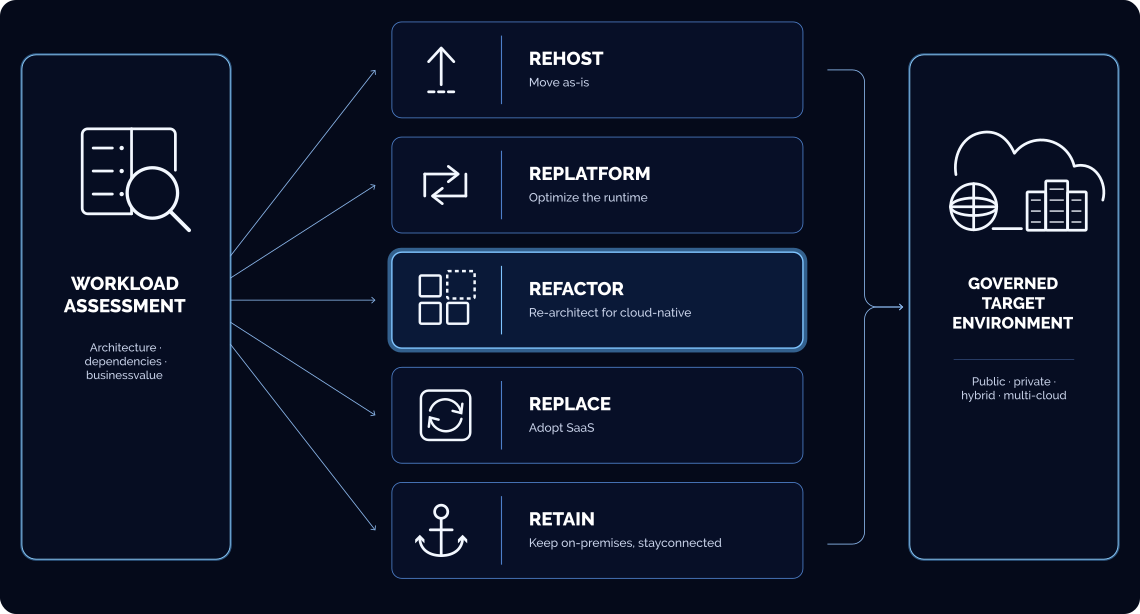
Choose the right migration path
Evaluate application architectures, technical debt, runtime dependencies, and lifecycle requirements to determine whether workloads should be rehosted, replatformed, refactored, replaced, or retained, maximizing modernization impact.
03
Align workloads to their target operating environment
Align workloads to public, private, hybrid, multi-cloud, or SaaS operating models based on performance, security, integration, and operational requirements to support scalability and efficiency.
04
Modernize progressively
Execute migration sequentially, decoupling dependencies, reducing risk, and maintaining service continuity while minimizing operational disruption.
05
Govern costs and performance after migration closes
Establish FinOps frameworks, integration governance, API management controls, and cloud cost visibility that prevent resource sprawl, maintain compliance, and ensure the environment continues to perform.
Our Cloud Migration Services
Many legacy applications remain tightly coupled to monolithic architectures, making them difficult to scale, evolve, and integrate with modern cloud environments.
Torry Harris modernizes legacy application portfolios through cloud-native architectures that improve scalability, deployment flexibility, and application reliability while reducing dependency on aging technology stacks.
We deliver
Application assessments that identify code seams, architectural dependencies, and modernization opportunities to establish a practical migration path
Microservices design and development that progressively reduce dependency on monolithic applications
Cloud-native application architectures that use containerization and orchestration frameworks to improve scalability and deployment consistency
Service mesh implementations that improve control, monitoring, security, and communication across distributed microservices environments
Cloud deployment models that align applications to public or private cloud environments based on operational, security, and business requirements
DevOps and CI/CD enablement that automates application delivery pipelines, accelerates release cycles, and improves deployment reliability
Platform and Tooling

Result:
Cloud-native applications that scale efficiently, deploy faster, evolve without the limitations of monolithic architectures, and are architecturally positioned to support AI integration and agentic capabilities.
Scaling a digital product becomes increasingly difficult when every customer requires dedicated infrastructure, operations, and upgrade cycles.
We help organizations transition from customer-specific deployments to SaaS operating models that introduce multi-tenancy, simplify service delivery, and support cost-efficient growth as customer adoption increases.
We deliver
SaaS enablement assessments that evaluate application architectures, tenancy requirements, operational models, and commercialization objectives to define the most suitable transformation approach
Multi-tenant application architectures that introduce tenant-aware data, identity, and application layers while maintaining security, isolation, and operational consistency
SaaS platform architectures that support scalability, replication, fault tolerance, and disaster recovery across cloud environments
Data migration frameworks that transition customer, application, and operational data from legacy environments to SaaS operating models with minimal disruption
FinOps and cost optimization models that improve resource utilization, tenant scalability, and cloud cost visibility as adoption grows
CI/CD, DevOps, and platform engineering practices that streamline application delivery, operational management, and ongoing SaaS evolution
Platform and Tooling
Result:
SaaS platforms that scale customers, services, and operations efficiently while improving agility, resilience, and cost control.
Changes in cloud strategy, platform requirements, cost objectives, or regulatory considerations may require applications and services to move between cloud environments without disrupting operations or compromising functionality.
Torry Harris helps organizations migrate applications and services between cloud platforms by aligning architectures, integrations, and cloud-native services to the target environment while maintaining application functionality, data integrity, and service availability.
We deliver
Cloud-to-cloud migration assessments that evaluate application architectures, cloud services, integrations, and dependencies to define the most effective migration strategy
Cloud service mapping frameworks that align capabilities across providers and identify where custom solutions are required to address platform-specific gaps
Application and workload migration services that transition workloads between AWS, Microsoft Azure, and Google Cloud while maintaining functionality, performance, and operational continuity
Data migration frameworks that preserve data integrity, consistency, and availability throughout the migration lifecycle
Integration modernization initiatives that strengthen hybrid integration across cloud and on-premises environments while maintaining application and data continuity
Migration validation and cutover frameworks that verify workload readiness and reduce transition risk before production deployment
Platform and Tooling
Result:
Applications, data, and services successfully transitioned between cloud environments with minimal disruption to business operations, performance, or user experience.
Relying on a single cloud provider can limit architectural flexibility, while unmanaged multi-cloud environments may create inconsistent security controls, fragmented data, and rising operational costs.
Torry Harris helps organizations establish multi-cloud operating models by defining workload placement strategies, enabling data synchronization across environments, and strengthening integration and security frameworks to support consistent operations across cloud providers.
We deliver
Multi-cloud strategy assessments that evaluate business, technical, resilience, and regulatory requirements to determine how cloud providers should be used across the enterprise
Use case-based workload placement frameworks that identify where applications, data, and services should operate based on performance, compliance, scalability, and operational requirements
Data synchronization architectures that maintain consistency, availability, and governance across cloud environments without creating duplicate or conflicting data sets
Security and access management frameworks that establish centralized governance controls, identity policies, and compliance standards across cloud providers
Integration modernization initiatives that enable applications, services, and data operating across cloud environments to exchange information reliably and securely
FinOps and cost optimization strategies that improve spending visibility, resource utilization, and operational efficiency across multi-cloud environments
Platform and Tooling
Result:
Workloads, data, and services operating across cloud providers with greater control over cost, resilience, provider dependency, and data sovereignty, along with the governance frameworks required to operate AI services responsibly across environments.
Business-critical applications, data, and processes are often distributed across on-premises and cloud environments. Moving everything to the cloud is not always practical, economical, or operationally desirable.
Our approach to hybrid cloud involves modernizing selected workloads, without sacrificing interoperability across environments by creating standardized approaches to data, identity, integration, and security across cloud and on-premises systems.
We deliver
Application assessments that identify candidates for rehosting, replatforming, refactoring, or retention based on modernization priorities and technical dependencies
Hybrid cloud architectures that combine public cloud services and private infrastructure to support workload mobility and operational flexibility
Data, identity, and security models that establish consistent governance and access controls across environments
Application containerization using Docker and Kubernetes to improve portability, scalability, and deployment consistency
Live VM migration services that support capacity expansion, workload mobility, and infrastructure optimization
Hybrid integration frameworks that maintain connectivity between cloud services, on-premises applications, and business-critical systems
Platform and Tooling
Result:
A hybrid operating model with greater flexibility to modernize workloads without forcing large-scale platform replacement or business disruption.
Managing infrastructure for application workloads can consume significant operational effort, even when those environments provide little competitive advantage to the business.
We help organizations transition applications to serverless architectures by redesigning services around event-driven execution models, enabling development teams to focus on application functionality while cloud platforms manage infrastructure provisioning, scaling, and availability.
We deliver
Serverless readiness assessments that evaluate workloads, runtime requirements, and service dependencies to identify suitable migration candidates
Application redesign services that transform legacy applications and web services into serverless architectures aligned to business and operational requirements
AWS Lambda implementations that replace application-specific services and business functions with event-driven serverless capabilities
Azure serverless migration services that modernize applications using Azure Functions, App Services, and microservices-based architectures
Google Cloud serverless implementations that leverage Cloud Run, Cloud Functions, and Service Integration capabilities to simplify application operations and scaling
Event-driven architectures that improve application responsiveness while reducing infrastructure management overhead
Platform and Tooling
Result:
Applications that scale automatically, reduce infrastructure management overhead, and enable faster delivery of new functionality.
Insights


WHITEPAPER
Microservices Strategy for Successful Cloud-Native Migration
Learn how enterprises can assess, plan, and implement microservices architectures to support cloud-native modernization while reducing the risks associated with monolithic application transformation.
read now
WHITEPAPER
Cloud Integration for Cloud Migration
Explore why integration strategy is critical to successful cloud migration and how organizations can avoid common migration challenges while improving scalability, agility, and operational efficiency.
read now
ARTICLE
Cloud-Smart Migration vs Lift-and-Shift: What CIOs Must Know
Discover how cloud-smart migration approaches help enterprises modernize applications, reduce risk, and avoid simply relocating legacy constraints into cloud environments.
read now
ARTICLE
Cloud Migration Strategy: The Ultimate Guide
Understand the strategic, architectural, and operational considerations involved in building a successful cloud migration roadmap, including modernization, integration, and hybrid cloud planning.
read now
Whitepaper
Migrating to a Hybrid Integration Platform (HIP)
Learn how hybrid integration strategies enable cloud adoption, connect on-premises and cloud environments, and support digital transformation without disrupting existing operations.
read now
Frequently asked questions
A cloud migration business case should evaluate more than infrastructure cost reduction. We assess scalability requirements, operational efficiency gains, application modernization opportunities, technical debt reduction, resilience improvements, and long-term operating model benefits — including the AI capabilities the target architecture will enable — to establish measurable business outcomes.
Large migration programs require application dependency mapping, workload prioritization, phased execution planning, and governance frameworks that coordinate migration activities across business and technology teams. This reduces execution risk while maintaining operational continuity.
Security, identity, governance, and regulatory requirements are incorporated into the migration strategy from the outset. Controls are designed around workload sensitivity, data residency requirements, access management policies, industry-specific compliance obligations, and emerging AI governance frameworks. For organizations operating across multiple jurisdictions, we design data sovereignty controls and workload placement strategies that address localization requirements, cross-border data transfer restrictions, and regulatory audit expectations.
Cloud cost management begins with workload placement decisions and continues through architecture optimization, resource governance, FinOps practices, utilization monitoring, and ongoing operational reviews to ensure cloud environments remain efficient as adoption grows.
Migration decisions should support long-term modernization goals rather than immediate infrastructure objectives. We evaluate application roadmaps, business priorities, AI adoption plans, technology strategy, and operating model requirements to ensure migration investments position the organization for what comes next. This includes the agentic AI operating models that are reshaping how enterprises deliver services and automate decisions.
Success metrics typically include application performance, operational efficiency, deployment velocity, scalability, resilience, cost optimization, business continuity outcomes, and AI infrastructure readiness. These measures are defined early in the migration program and tracked throughout execution and post-migration operations, including the degree to which the target environment accelerates AI adoption.
Contact us
Follow us


