Cloud management & security
Built for enterprises governing hybrid and multi-cloud at scale
Govern the cloud at the speed it grows, with policy built into the platform. Torry Harris builds security, compliance, and risk controls directly into the cloud platform, automating governance at the infrastructure layer so every deployment stays compliant without extra reviews.
What every cloud governance decision comes down to
Five decisions determine whether governance keeps pace with cloud adoption or falls a step behind it:
01
Enforcement point:
Are controls built into the platform and applied when an environment is created, or added afterward and confirmed at audit time?
02
Compliance cadence:
Is your compliance position current on any given day, or assembled in the weeks leading up to a review?
03
AI coverage:
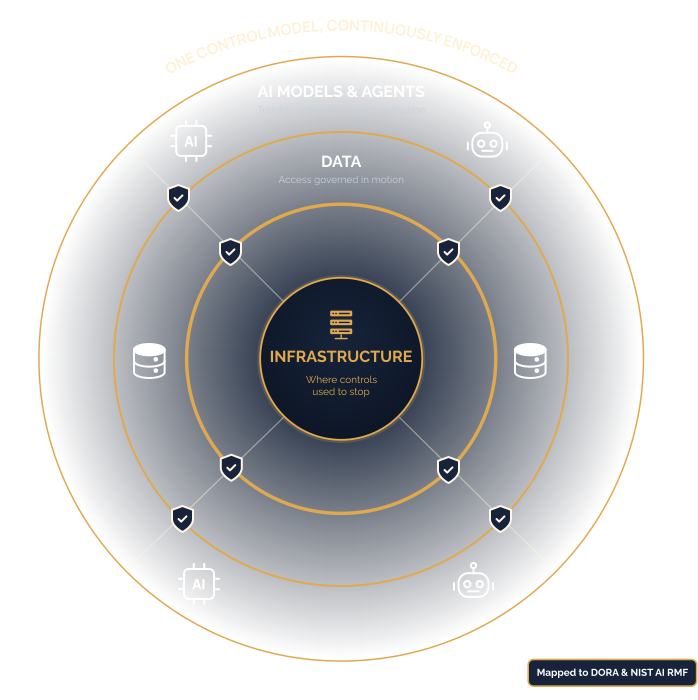
Do your controls follow data into model training, inference, and agent execution, or do they stop at a boundary AI workloads now cross as routine work?
04
Friction:
Policy that slows delivery gets routed around. Can yours be enforced automatically inside the pipeline, so meeting it costs a developer nothing in waiting time?
05
Framework mapping:
Are controls mapped to DORA, the NIST AI RMF, GDPR, HIPAA, PCI DSS, SOC 2, and ISO 27001 in one place, or maintained separately for each audit?
OUR APPROACH
How Torry Harris works with you
We treat security and compliance as platform properties that are assessed once, enforced automatically, and monitored while the environment runs.
01
Start with what is exposed today
Before any new control is written, measure risk across applications, infrastructure, identities, and services so that enforcement is built with a complete picture.
02
Make access the first control
Design and enforce least-privilege identity policies across distributed and hybrid environments. Who can reach what gets settled before anything else does.
03
Write the controls as code
Security and compliance rules go into the delivery pipeline itself, validated continuously against the frameworks your organization answers to.
04
Watch the running environment
Detection covers policy violations, configuration drift, and emerging risk in real time. Defined violations are remediated automatically, whereas the ambiguous ones reach the team.
05
Extend the model to AI
The same controls apply to data access, model usage, and agent execution, mapped to DORA and the NIST AI RMF, so oversight arrives with the initiative and not after it.
Our cloud management & security services
Most enterprises can name every security tool they have deployed. The stronger position is knowing exactly where those tools reach, and where responsibility passes from one control to the next. The gap usually sits in between an identity nobody owns and a service account that outlived the project it was created for, or a workload provisioned outside the standard.
Torry Harris measures risk exposure across applications, infrastructure, identities, and services before producing a ranked view of what is missing before new controls are designed.
We deliver
Risk exposure assessment across applications, infrastructure, identities, and cloud services
Gap analysis mapping current controls to the frameworks your organization has to satisfy, so the output doubles as audit evidence
A ranked findings list. Urgent exposure is separated from technical debt that can wait, and the reasoning behind each placement is shown
Baseline posture scoring, which gives the program a measurable starting point and a way to report progress to the board
Identity sprawl and privilege accumulation analysis across hybrid and multi-cloud environments
Remediation sequenced by risk reduced per unit of effort
Platform and Tooling

Result:
A verified map of where controls exist and where they do not, with findings ordered so the first quarter of remediation work removes the most risk.
Access is easiest to control at the moment it is granted. An engineer moves off a project, a service account finishes a one-off migration, and each one is a clean point to withdraw permissions before they sit unused. Most enterprises already have this information. What is missing is the schedule that acts on it automatically.
Torry Harris designs and enforces least-privilege access across distributed and hybrid environments, so permission is granted deliberately and withdrawn on a schedule.
We deliver
Least-privilege access models designed for distributed, hybrid, and multi-cloud environments
Identity governance with a defined review and rotation cadence. Permissions expire on schedule, and dormant access is withdrawn without anyone raising a ticket.
Privileged access management for the accounts and service identities that would do the most damage if compromised
A centralized identity architecture, replacing per-environment access rules with one model your architects maintain in a single place
Secrets management that takes hardcoded credentials out of applications and pipelines
Access reviews mapped to compliance frameworks, so the evidence an auditor asks for already exists when they ask
Platform and Tooling
Result:
Access that can be proved current at any point. Audit preparation gets shorter, and the number of standing permissions an attacker could pick up goes down.
Policy-as-code means writing a security or compliance rule as a machine-readable check that runs inside the delivery pipeline. Every change is tested against that policy automatically, rather than through a manual review that happens only on the day someone performs it.
Torry Harris codifies your controls as policy-as-code and validates them continuously against GDPR, HIPAA, PCI DSS, SOC 2, ISO 27001, NIST, and the sector standards that apply to your business.
We deliver
Policy-as-code libraries applied automatically at build and at deployment
Continuous validation against GDPR, HIPAA, PCI DSS, SOC 2, ISO 27001, NIST, and sector-specific standards
Pipeline integration that stops a non-compliant change before it reaches production
Compliance evidence that stays current on its own. Audit preparation becomes an export of what already exists.
Exception workflows for genuine edge cases, routed for review without holding up everything else moving through the pipeline
Infrastructure-as-code scanning, which catches a misconfiguration while it is still text in a pull request
Platform and Tooling
Result:
Compliance that is true on any given day. Audit cycles stop being projects.
A quarterly review tells you what went wrong three months ago. Continuous monitoring tells you within minutes, closing the same kind of misconfigured storage permission or drifted firewall rule while the quarterly cycle would still be three months from catching it.
Torry Harris puts detection and automated response into the running environment, so violations with a known correction close as they appear and your analysts are called in for the cases that need judgment.
We deliver
Real-time detection of policy violations, configuration drift, and emerging risk across cloud and hybrid environments
Automated remediation for every violation that has a defined and safe correction
Risk correlation across identities, workloads, and network activity, which surfaces the pattern a single alert would never show
Escalation reserved for ambiguous cases. Analysts stop triaging issues the system has already handled, and alert volume drops.
Monitoring dashboards giving security, compliance, and platform teams one current view of exposure
Incident response integration connecting each detection to the runbook and the team accountable for it
Platform and Tooling
Result:
Exposure measured in minutes. Routine violations close themselves, and your security team spends its attention where humans can add value.
Governance built a couple of years ago assumed that applications just read a database. AI systems reach data on their own, call tools independently, and produce output with regulatory weight, so the same controls now need to stretch further without being rebuilt.
Torry Harris extends your existing control model to cover AI, with traceable data and compute access, model usage held inside defined boundaries, and mapping to DORA and the NIST AI RMF.
We deliver
AI usage policies defining which data, models, and compute a given system can reach, and under what conditions
Model governance covering lineage, approved usage boundaries, and named accountability for every deployed model
Data access controls extended to training and inference workloads
Compliance mapping to the NIST AI RMF, DORA, and the sector frameworks your organization already reports against
Monitoring for the risks specific to AI: model drift, unauthorized data access, and usage outside the approved boundary
Governance onboarding for new AI initiatives. A team starting a project receives the controls along with the environment, with no separate approval cycle to sit through.
Platform and Tooling
Result:
AI initiatives begin inside the governance model. Your risk function can answer what a model touched, who approved it, and which framework covers it.
Insights


news
Torry Harris is a finalist in TM Forum’s Moonshot Catalyst Awards 2024
With cross-industry collaboration, secure data-sharing and together with other tech giants and CSPs, Torry Harris has built a powerful, proactive shield against fraud on telco networks using AI agents.
read now
Case Study
Automating API conformance cuts Vodafone’s integration costs by multiple millions and other benefits
See how automated conformance checking cut API deviations by 90% and reduced integration cost by 76% against manual review.
read now
Case Study
Scalable IT modernization: How GBK achieved a 50% surge in integration efficiency and security with Torry Harris
See how a regulated bank raised integration efficiency and security by 50% through a governed API gateway.
read now
Frequently asked questions
With an assessment, because enforcement built on an incomplete picture protects the wrong things well. Measuring exposure across applications, infrastructure, identities, and services shows which gaps carry real risk and which are technical debt that can wait. That ranking matters more than the gap list itself, since most security backlogs are longer than any quarter's capacity. The first controls written should be the ones that close the exposure your assessment ranked highest.
The opposite, in most programs we have run. A policy check inside the pipeline returns a result in seconds, and it returns it to the developer who can act on it at the moment. The friction teams associate with governance almost always comes from bolted-on checks and a review board that meets weekly, or a security sign-off that arrives after the code is written. Automating the rule removes the wait, and it removes the incentive to work around the rule.
An assessment establishes where controls exist and where the gaps are on the day it is performed. Continuous monitoring watches the running environment and catches violations and drift as they occur. The two do different jobs, and most enterprises need both: the assessment tells you where to concentrate, and the monitoring stops the picture going stale the week after you fix things.
The enforcement mechanism does not change. Policy-as-code and access control are applied to a wider surface on the data a model can reach, the compute it can consume, the tools an agent is allowed to call, and the boundaries its output has to stay inside. Compliance mapping extends to the NIST AI RMF and DORA alongside the frameworks you already report against. Most governance programs were scoped before agentic systems were in production, which is why this reads as new work even though the underlying control model is the one you already have.
Controls are mapped to GDPR, HIPAA, PCI DSS, SOC 2, ISO 27001, DORA, and the NIST AI RMF, plus sector-specific standards where they apply. The mapping lives in the policy-as-code layer, which means a control is written once and satisfies every framework that requires it. For enterprises reporting against four or five frameworks at once, that single mapping is usually where the audit preparation savings come from.
No. Those are the tools this practice operates on. A CNAPP platform tells you what is wrong across the environment; it does not decide which findings matter most to your business, write the policy that stops the problem recurring, or embed that policy in your delivery pipeline. Torry Harris does that work on top of the tooling you have already bought, and we work with the major platforms rather than requiring a particular one.
Cloud security architects and GRC leads usually own day-to-day policy enforcement. The CISO and CIO sponsor the program jointly, since it affects risk posture, delivery speed, and audit cost across every team. Platform engineering stays involved throughout, because the controls live inside the infrastructure they operate, and a control nobody on the platform team understands is a control that gets disabled the first time it blocks a release.
Cloud Managed Services keeps operations running day to day, such as observability, cost management, delivery automation, and incident handling. Cloud Management and Security defines the policy, identity, and compliance controls those operations run inside. One runs the environment. The other decides what running it safely means, and enforces that decision automatically.
Cloud Transformation standardizes the infrastructure, which means the landing zones and provisioning templates every environment inherits. Cloud Management and Security determines what those templates have to enforce, and validates that they keep enforcing it once environments are live. Standardization gives the controls a single place to live. Governance decides what goes in it. Enterprises that run the two together usually find the second is much cheaper, because the control is written once for the blueprint instead of separately for every environment.
Twenty-five years of integration work where we build governance as code into the platform layer rather than delivering a security overlay that sits beside it and needs its own maintenance. We lead with the AI governance extension, whereas only a handful of firms with an integration heritage have taken data access and model usage into scope against DORA and the NIST AI RMF, leaving a gap where most enterprises end up exposed.
Get in touch
Follow us


