
With how we see the world growing, Global Capability Centers are no longer just about cutting costs, for many enterprises, they've become the fastest, most reliable way to build and scale AI capability at pace. How? Pair a smart micro-GCC design with nearshore locations and the right operating framework, and you suddenly have a setup that delivers faster time-to-value, lower risk, and genuine business agility.
At Torry Harris we see this shift every day. Our AIM Framework – AI + Integration + Managed Services gives leadership teams a practical way to turn a traditional GCC (or start a new one) into a true strategic asset.
Why AI in GCC is now a boardroom priority
Talent shortages, tighter data regulation, and the need to move faster have put AI in Global Capability Centers firmly on the agenda. European and UK firms can no longer rely solely on local hiring or big-bang onshore projects. A controlled, scalable GCC, especially a smaller, focused one has become the most practical engine for enterprise-wide AI adoption.
What started as shared services has evolved into proper digital hubs. Leadership teams now look to these centers for speed, compliance, predictability, and real innovation.
A few examples we see regularly:
- Telco: network automation and predictive operations
- BFSI: fraud detection, regulatory reporting, credit analytics
- Retail: demand forecasting and customer personalization
- Healthcare: clinical data insights and real-world evidence analytics
- Government: digital public services and compliance automation
- FinTech: risk modelling, AML, and onboarding automation
How AI automation accelerates GCC agility and lowers operating costs
It is a well established fact for now that AI automation removes repetitive manual work and dramatically speeds up service delivery. For for CXOs what does this translates to?
To answer briefly: It translates into teams that can respond to change without the usual friction. Here are some typical areas we automate end-to-end inside GCCs:
- HR operations
- IT service management
- Finance and vendor processes
- Compliance reporting
Torry Harris combines process redesign, intelligent automation of complex workflows, smart knowledge management, and proactive SLA prediction. The result is a leaner, faster operation.
Micro GCCs amplify the benefit - smaller scope means faster adoption cycles, lower risk, and quicker ROI.

Predictive analytics in GCCs: Transforming decision-making and forecast accuracy
Predictive analytics in GCCs gives leadership early warnings, sharper forecasts, and the confidence to act sooner. It's become essential for CXOs, and strategy teams who need to reduce surprises and improve planning accuracy.
Common applications of predictive analytics include:
- BFSI: credit scoring, fraud prediction, KYC automation
- Retail: supply-chain and demand forecasting
- Telco: churn prediction and network capacity planning
- Healthcare: patient outcome modelling
- FinTech: dynamic risk assessment
By leveraging strengths in big data, cloud platforms, advanced analytics, and digital engineering, these capabilities deliver measurable improvements in cost control and business agility.
Micro GCCs + AI: A New Model for Faster Time-to-Value and Scalability
Large, multi-thousand-seat GCCs are giving way to focused micro capability centers, especially among European enterprises. The advantages are clear:
- Faster setup and lower initial cost
- Deep domain specialization
- Closer alignment with business decision-makers
- Simpler governance and compliance
Micro GCCs are perfect for AI pilots, rapid prototyping, and scaling proven solutions. Torry Harris' end-to-end concept-to-build approach, combined with AI/ML and digital engineering expertise, matches this model perfectly.
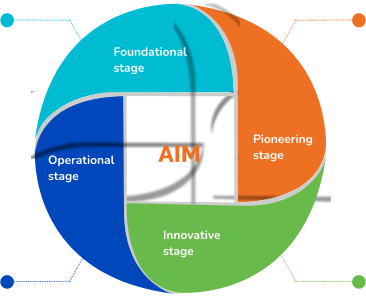
The AIM framework: A blueprint for AI-driven GCC modernization
The AIM Framework – AI + Integration + Managed Services – provides a structured, repeatable way to modernize or launch an AI-first GCC.
It accelerates:
- AI maturity across the enterprise
- System integration and interoperability
- 24×7 managed operations
- Continuous innovation
For UK and European companies with strict compliance and data-governance requirements, AIM delivers the predictability and control leadership teams need.
AI in GCC for UK & Europe: Compliance, sovereignty & nearshore advantage
UK and EU enterprises face non-negotiable requirements around data sovereignty, GDPR, and the EU AI Act. An intelligently designed GCC can meet every rule while still delivering speed and cost advantage.
Nearshore locations such as Poland, Portugal, Romania, and Spain have become popular because they keep data inside the EEA and offer strong engineering talent pools. Torry Harris structures these centers with compliant tax and legal setups, robust data-security practices, and flexible delivery models (Build-Operate-Transfer or dedicated ODCs).
AI skill hubs: How AI-powered GCCs solve Europe's digital talent bottleneck
The shortage of AI, data, and cloud skills across the UK, Germany, Netherlands, and Nordics is now a strategic blocker for many leadership teams. An AI-focused GCC effectively becomes an extension of your talent pool – delivering model engineering, data engineering, MLOps, and cloud modernization at scale.
Our Talent Sourcing and Talent Optimization services help clients build and retain the right mix of capabilities without competing head-on with the hyperscalers.
AI-powered GCC operating models: What CXOs need to know in 2026
In the next 12–24 months, the most successful GCCs will operate as enterprise-wide AI platforms. Expect automated governance, real-time performance dashboards, AI-driven SLA monitoring, and predictive decision support as standard.
Torry Harris' Performance & SLA Management and Service Delivery Optimization practices are built specifically for this new operating reality.
Case examples: How AI-powered GCCs are delivering measurable impact in Telco, BFSI & Retail
Across sectors we're seeing clear, repeatable outcomes:
- BFSI clients reducing fraud investigation cycles using AI detection and automation
- Telco operators improving network planning accuracy with predictive analytics
- Retail businesses lifting conversion through real-time customer analytics
- Healthcare providers streamlining clinical data harmonization and triage
These results come from combining a focused GCC Center of Excellence with AI/ML and digital engineering capabilities.
How to get started: Building an AI-powered GCC with Torry Harris
The fastest path we've seen:
- Discovery & GCC Advisory Assessment
- Rapid micro-GCC prototype
- Roll out the AIM Framework
- Establish AI CoE, integration backbone, and managed services
- Scale proven use cases across the enterprise
To map the shortest route from strategy to live value
Talk to our GCC experts today!
Frequently asked questions
By automating repetitive tasks, accelerating processes, and enabling predictive operations across functions.
A balanced mix of AI/ML engineers, data engineers, integration specialists, domain experts, and strong delivery management.
Yes – lower setup costs, faster value realization, and ongoing efficiency gains typically deliver superior economics.
BFSI, telecommunications, retail, healthcare, FinTech, and public sector are seeing the strongest returns.
Begin with a focused assessment, pilot high-impact use cases, and partner with an experienced provider to accelerate delivery.

|
Shreya KapoorSenior Content Strategist |