
In most telecom organizations, OSS/BSS systems are seen as the biggest barrier to transformation.
They are labelled:
- Legacy
- Complex
- Difficult to change
And so, the default response is clear:
Replace them.
This thinking has shaped OSS/BSS modernization strategies across the industry for years.
But what if the systems themselves are not the real problem?
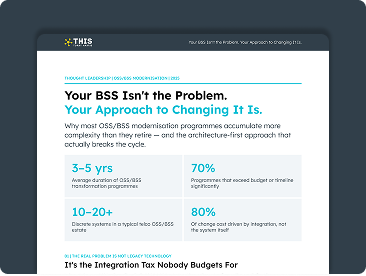
Why Replacing OSS/BSS Systems Doesn't Solve the Problem
Many operators have already invested in replacing or upgrading their OSS/BSS platforms.
Yet the outcomes often look familiar:
- Change remains slow
- Costs remain high
- Complexity persists
This suggests that the issue is not simply about technology.
It is about how transformation is approached.
The Real Issue: How Change Is Structured
In most telecom environments, OSS/BSS systems are deeply interconnected.
They support:
- critical business processes
- network operations
- customer interactions
Replacing them without rethinking the surrounding structure often leads to limited improvement.
This is where integration architecture becomes critical.
If systems remain tightly coupled, even modern platforms behave like legacy ones.
A Strategy Problem, Not a Technology Problem
Many OSS/BSS modernization efforts follow similar patterns:
- Focus on system replacement rather than system interaction
- Prioritise platform selection over architectural design
- Treat integration as a secondary concern
These choices shape the outcome of the entire programme.
Even the most advanced systems cannot deliver value if they are implemented within the same structural constraints.
Rethinking Legacy Modernization
True legacy modernization is not just about replacing systems.
It is about enabling change across the organization.
This requires:
- Decoupling systems from each other
- Reducing dependency chains
- Enabling flexibility in how services are delivered
Without this shift, modernization becomes a cycle rather than a solution.
The Role of Orchestration in Modern OSS/BSS
As telecom environments evolve, orchestration becomes a key capability.
It allows organizations to:
- Coordinate processes across systems
- Automate workflows end-to-end
- Deliver services without manual intervention
However, orchestration is only effective when supported by a strong integration architecture.
Without it, automation remains limited and fragmented.
A Different Approach to OSS/BSS Modernization
Operators that are seeing better outcomes are changing how they approach transformation.
Instead of starting with systems, they start with architecture.
Instead of focusing only on replacement, they focus on:
- integration
- orchestration
- incremental change
This creates a more flexible foundation for long-term transformation.
What This Means for Telecom Leaders
For CIOs and transformation leaders, the key question is shifting.
It is no longer:
"Which system should we replace?"
But:
"How should we structure change across the organization?"
This perspective changes how investment decisions are made — and how outcomes are achieved.
Conclusion
OSS/BSS systems are often seen as the root cause of telecom transformation challenges.
But in many cases, the real issue lies in the approach to modernization.
Focusing on integration architecture, orchestration, and structured legacy modernization enables organizations to move beyond system replacement and achieve meaningful change.
For deeper insights on this topic, download the full report
Frequently asked questions
Level 3 Communications, now part of Lumen Technologies, is one of the well-known providers behind these numbers. They are built to handle voice portals, call centers, and even big conferencing systems.
The four types of telecommunication services are voice services, data services, video services, and internet services, enabling communication, information sharing, and multimedia exchange across distances.
Telecom modernization transforms outdated, legacy infrastructure into agile, cloud-native, and AI-driven networks. This process enhances scalability, security, and efficiency, reducing operational costs by up to 60%. Key strategies include implementing hybrid cloud, edge computing, AI-assisted automation, and API integration, allowing operators to deploy 5G and new services faster.
Telecom trends in 2026 are defined by the transition from 5G to AI-native, autonomous networks, the rise of agentic AI for operations, and 6G development.
Network modernization is the process of replacing or augmenting legacy network infrastructure with services that support cloud-based connectivity and security services.

|
Pankaj KulkarniSenior Manager Research & InisghtsTorry Harris Integration Solutions |