-
Home

-
Knowledge Zone
- How API integration enables telcos to deliver fintech access to remote populations via satellite networks
For billions of people living in remote areas - rural farmlands, island communities, mountain villages, and off-grid settlements - the question is not which bank to choose or which payment app to download. The question is whether any financial service can reach them at all.
No bank branch. No ATM. No cellular signal. No internet connection. And without internet, no access to the fintech platforms that the rest of the world uses to send money, borrow credit, save digitally, or receive insurance payouts.
Satellite networks are changing that reality. And API integration is the technical reason why the change actually works.
This guide explains, in plain terms, how satellite connectivity reaches people that terrestrial networks never will, how fintech platforms connect to those satellite networks through API integration, and what that combination means for a farmer in Sub-Saharan Africa, a fishing family in a Pacific island community, or a trader operating along a remote border corridor.

Who are the people that satellite fintech is built to serve?
Before explaining the technology, it is worth being specific about who this affects and why it matters.
The World Bank estimates that approximately 1.4 billion adults worldwide remain completely unbanked - they hold no account at a bank, credit union, or mobile money provider. A further 1 billion are underbanked, meaning they hold a basic account but have no access to credit, insurance, or savings products.
These populations share a common characteristic: they live where infrastructure does not reach. Not because they lack economic activity - most are farmers, traders, artisans, or informal economy participants with real income and real financial needs. They are excluded from the financial system for one reason: no reliable internet connection exists where they live.
This is the gap that satellite networks exist to close. And API integration is the mechanism that turns a satellite internet connection into a working fintech product in someone's hand.
Why terrestrial networks have never reached remote areas
To understand why satellite matters, it helps to understand why traditional connectivity has failed remote populations for decades.
Terrestrial internet infrastructure - fiber-optic cables, 4G cell towers, copper telephone lines - is built by private companies that need a return on investment. Running fiber cable through a mountainous region to serve a few hundred households costs millions of dollars. Building a cell tower in a remote agricultural district that earns a few hundred dollars per month in subscriptions takes decades to become profitable, if it ever does.
Private telecoms do not build infrastructure where the economics do not work. This is not a moral failure. It is the predictable outcome of a market-driven infrastructure model.
The consequence is that the same communities that lack schools, hospitals, and paved roads also lack internet - not because no one tried, but because the cost of reaching them through terrestrial infrastructure exceeds any realistic commercial return.
Satellite networks operate under a completely different economic model. A single LEO satellite passing overhead covers thousands of square miles in a single pass. The marginal cost of adding one more household or one more village to the coverage area of an existing satellite constellation is nearly zero. The infrastructure investment is made once, in orbit, and serves every person beneath it simultaneously.
How satellite networks deliver internet access to remote areas
What changed: From slow GEO satellites to fast LEO constellations
For most of the satellite internet era, the technology was too slow to support real financial transactions. Geostationary (GEO) satellites orbit approximately 35,786 kilometers above Earth. A signal traveling from a remote village to a GEO satellite and back takes 480 to 600 milliseconds for a single round trip. That delay - called latency - creates serious problems for payment systems, because a typical transaction requires multiple sequential round trips - for TLS handshakes, authentication exchanges, and data verification. These delays stack up, pushing total transaction time well beyond what payment protocols and users can tolerate, even when individual timeout thresholds are set in the range of 30 to 60 seconds.
Low Earth Orbit (LEO) satellites operate at altitudes between 500 and 1,200 kilometers. The round-trip signal delay drops to 20 to 40 milliseconds - fast enough for real-time payment processing, video calls, and the kind of interactive banking sessions that fintech platforms require.
| What it means for a remote user | GEO satellite | LEO satellite |
|---|---|---|
| Can complete a mobile payment | No - times out | Yes - works in real time |
| Can verify identity for a loan application | No - session breaks | Yes - stable session |
| Can receive an insurance payout notification | Delayed | Immediate |
| Affected by local floods or power cuts | No | No |
| Requires a cell tower nearby | No | No |
How a remote person actually gets connected
The hardware required to connect a remote household or village to a LEO satellite network is a small dish antenna - roughly the size of a pizza box - and a Wi-Fi router. The dish is pointed at the sky, not at a specific satellite, and automatically tracks LEO satellites as they pass overhead at orbital speed.
Once installed, the connection behaves like a standard internet connection. A person in a remote village with a satellite terminal can open a fintech app, enter a mobile wallet, apply for a micro-loan, or receive a payment - using the same application a person in a city uses on a 4G phone, with nearly the same speed.
The satellite is the substitute for the cell tower and the fiber cable that never arrived.

What financial services can remote people access through satellite connectivity?
Satellite connectivity alone does not deliver financial services. It delivers internet access. The financial services are delivered by fintech platforms - software products that run on that internet connection.
Here is what becomes accessible to a person in a remote area once satellite connectivity is established:
Mobile wallets and digital payments
A mobile wallet is a digital account linked to a phone number or identity document. It allows a person to receive money, send money, and pay for goods and services without a physical bank account or a bank branch nearby.
For a remote area farmer who previously had to travel hours to a town to receive a cash payment for their harvest, a mobile wallet connected through a satellite link means the buyer can transfer the payment digitally, instantly, to the farmer's phone. The farmer does not travel. The cash does not change hands. The transaction settles in seconds.
The satellite network's role: Provides the internet connection that the mobile wallet application uses to communicate with the payment platform.
The API integration's role: Connects the mobile wallet platform to the satellite network's data channel, ensuring the transaction is routed correctly, authenticated securely, and confirmed in real time even when the satellite connection has variable speed or brief interruptions.
Micro-loans and digital credit
Banks require formal documentation to issue loans: proof of income, bank statements, land titles, employment records. Most people in remote areas have none of these. They are not poor credit risks - they have consistent income from farming, fishing, or trade - but they are invisible to formal lenders because they have no paper trail.
Satellite-connected fintech platforms solve this in two ways.
First, the satellite connection allows the borrower to establish a digital transaction history. Every mobile payment received, every digital purchase made, and every micro-savings deposit creates a data record. Over time, this transaction history becomes an alternative credit file - evidence of financial reliability that did not exist before satellite connectivity.
Second, satellite-based earth observation data provides an additional credit signal that requires no documentation at all. A fintech lender can access satellite imagery of a farmer's land through an API integration with a satellite data provider, analyze five years of crop health and yield patterns, and generate a credit assessment based on observable, physical evidence. The farmer receives a loan decision on their mobile phone in minutes - no branch visit, no paperwork, no collateral requirement.
The satellite network's role: Delivers the internet connection for the loan application and transmits earth observation data from satellite sensors to the lending platform.
The API integration's role: Connects the lending platform to both the satellite internet layer and the satellite imagery data layer through structured API calls, allowing the platform to request imagery, receive credit signals, and process the loan decision without manual intervention.
Savings accounts and wealth protection
For people in remote areas who have historically relied on physical cash, the risks are significant. Cash can be stolen, lost in a fire, or destroyed in a flood. In regions experiencing currency instability, holding cash means watching its value erode.
A digital savings account connected through satellite banking gives a remote area household a secure place to store value that is not vulnerable to physical loss. Deposits earn interest. The balance is protected by the fintech platform's security infrastructure. And because it is digital, it can be sent to a family member, used to pay a vendor, or withdrawn at a satellite-connected ATM without requiring a bank branch.
The satellite network's role: Provides the connectivity for deposit transactions, balance checks, and withdrawal authorizations.
The API integration's role: Connects the savings platform to the satellite network for transaction routing and to the ATM's hardware interface for cash dispensing, with encrypted API calls verifying every transaction in real time.
Insurance and parametric payouts
Agricultural insurance has historically been unavailable to smallholder farmers in remote areas because the cost of verifying a claim - sending an adjuster to inspect a field after a drought or flood - exceeds the value of many small claims. The insurance product cannot be priced affordably because the operating cost of delivering it is too high.
Satellite connectivity combined with IoT sensors and API integration changes the economics completely.
IoT weather sensors placed in a farmer's field transmit soil moisture, temperature, and rainfall data through a satellite connection to an Insurtech platform. When the data shows that a drought or flood has crossed the threshold defined in the farmer's policy, the platform automatically confirms the event using satellite weather imagery and triggers a payout. No adjuster visits. No claim form. No delay.
The farmer receives the insurance payment to their mobile wallet within 24 hours of the qualifying weather event.
The satellite network's role: Transmits IoT sensor data from the field to the insurtech platform and delivers the payout confirmation back to the farmer's device.
The API integration's role: Connects the IoT sensor data stream, the satellite weather imagery source, and the insurance payout system through a unified API layer. When sensor data crosses the payout threshold, the API integration triggers the satellite imagery verification and the smart contract payout automatically - no human decision required.
Remittances and cross-border transfers
Workers from remote communities who migrate to cities or other countries to earn income regularly send money home to their families. The formal remittance industry charges fees of 5 to 10 percent on each transfer, and the recipient often needs to travel to a physical agent location to collect the cash.
Satellite-connected remote banking solutions allow the recipient family in a remote area to receive remittances directly to a mobile wallet - no agent location required, no travel, no cash pickup. The sender initiates the transfer from their city or country. The satellite connection delivers the confirmation to the recipient's device in real time.
The satellite network's role: Provides internet connectivity to the recipient's device in an area where no cellular signal reaches.
The API integration's role: Connects the remittance platform's cross-border transfer rails to the satellite network's data channel and to the recipient's mobile wallet, ensuring the transfer clears international payment systems, converts currency at the correct rate, and delivers to the correct account.
How API integration makes satellite fintech work in practice
Satellite connectivity gives a remote person access to the internet. API integration is what ensures that the fintech platform on that internet connection actually functions reliably under satellite conditions. These are two separate problems, and understanding the difference explains why API integration is not optional — it is the reason remote banking solutions work instead of fail.
The problem API integration solves for remote users

A fintech app designed for a 4G urban network makes assumptions that break over a satellite connection:
It assumes the connection is always available. It is not. Satellite connections can drop briefly during the handoff between orbital passes or during heavy rainfall.
It assumes data transfer is fast and cheap. It is not always. Satellite bandwidth is more constrained than fiber, and data costs more per gigabyte.
It assumes a transaction that starts will complete in a single continuous session. It may not. If the satellite connection drops mid-transaction, the app needs to know whether the transaction completed or not - and what to do next.
Without API integration designed for these conditions, a remote user's experience is: open the app, start a transaction, lose the connection, reopen the app, try again, see a confusing error, give up. That is not financial inclusion. That is a product that doesn't work.
How API integration fixes each problem
Dropped connections - solved with asynchronous processing. A satellite-optimized API integration uses an asynchronous architecture. When a user submits a payment, the app immediately sends the transaction to the satellite-facing API gateway and receives a transaction ID as confirmation. The transaction is queued and processed. The user's phone can close the app, lose signal, and reconnect later — and the transaction will have completed. The API management solution holds the transaction state and delivers the confirmation when the connection is restored.
Data cost - solved with payload compression. API integration designed for digital satellite services compresses every data exchange between the fintech app and the platform. A standard payment API call that sends 50 kilobytes of data over a fiber connection is reengineered to send 8 to 12 kilobytes over a satellite link - the same transaction, the same security, a fraction of the data consumed. This keeps satellite data costs manageable for low-income users on metered connections.
Duplicate transactions - solved with idempotency. If a dropped connection causes a user to submit the same payment twice, an API integration built with idempotency guarantees recognizes the duplicate request and processes it only once. The user never accidentally sends money twice because the satellite dropped for three seconds.
No connection at all - solved with edge computing. The most resilient remote banking solutions use edge computing at the satellite terminal itself. When the satellite link is unavailable, the fintech app processes and stores the transaction locally on the terminal device. When the satellite connection is restored - even if it is hours later when the next satellite passes overhead — the transaction is transmitted automatically and settled. From the user's perspective, they submitted a payment and it went through. They do not need to know that it was held locally for three hours during a connectivity gap.
Real situations: How satellite fintech and API integration change daily life in remote areas
A farmer in rural Kenya
Amara grows maize on a smallholding three hours from the nearest town. There is no bank branch within reach. The nearest ATM is in town and frequently out of service. She has historically been paid in cash by local traders who know they have pricing power because she has no alternative buyer.
After a satellite terminal is installed at the local agricultural cooperative, Amara downloads a fintech app connected to the satellite network through API integration. She opens a mobile wallet. She begins receiving payments directly from a regional grain aggregator who finds her through a digital marketplace. She saves a portion of each payment in a micro-savings account. She applies for a seasonal crop loan - and is approved within an hour based on satellite imagery analysis of her land. She receives a drought insurance payout automatically when a dry season exceeds the threshold in her policy.

None of this required a bank branch, a loan officer, an insurance adjuster, or a trip to town. The satellite network carried every transaction. The API integration made every transaction reliable.
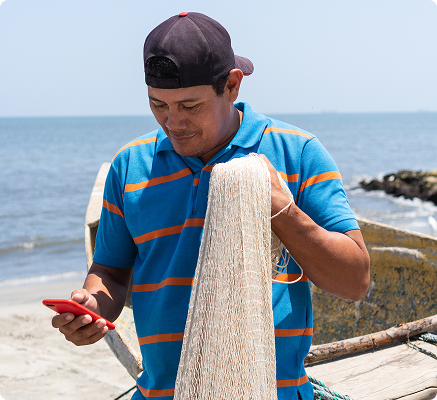
A Fishing Community in the Philippines
A remote island community of two hundred fishing families has no cellular coverage and no bank. Fishermen sell their catch to a buyer on the island who pays in cash and sets prices with no competition.
A satellite terminal installed at the community center changes the commercial dynamic. Fishermen can now list their catch on a digital marketplace accessed through the satellite link. They receive mobile wallet payments from buyers in the city. They send remittances to children studying on the mainland. They access micro-loans to buy better nets and engines, repaid automatically from digital payment receipts.
The API integration layer connecting the fintech platform to the satellite network ensures that transactions complete even when weather degrades the satellite signal - the edge computing module holds transactions locally and transmits them when the signal stabilizes.
A Trader at a Remote Border Crossing
Marcus coordinates freight shipments across a land border between two countries. The crossing is in a rural corridor where no cellular signal exists. He has carried large amounts of cash for years to pay customs duties and release shipments. He has been robbed twice.
A satellite-connected payment terminal at the crossing - integrated through API management solutions to a cross-border payment platform - allows him to authorize payments digitally. Customs duties are paid by mobile transfer. Shipment releases are confirmed automatically. The API integration handles currency conversion, compliance screening, and settlement across two jurisdictions in real time, over a satellite link.
He carries no cash. The supply chain moves faster. The risk is gone.

What makes API integration the critical layer between satellite and fintech
It is worth being direct about why API integration specifically - not just satellite internet - is the reason remote banking solutions work.
Satellite internet gives a remote person the same internet connection that an urban person has. But the fintech platforms built for urban users do not automatically work for remote users. They were not designed for the connectivity conditions, the data cost constraints, or the intermittent availability that satellite links involve.
API integration is the engineering work that adapts fintech platforms to satellite environments. It is the compliance layer that ensures a cross-border transaction over a satellite link meets the same regulatory requirements as a transaction over fiber. It is the data compression layer that makes a payment affordable on a metered satellite connection. It is the retry and queuing logic that ensures a transaction completes even when the satellite signal drops.
Without API integration, satellite internet access and fintech platform access are two separate things. With API integration, they become a single, seamless experience - a person in a remote area opens a banking app and it works, the same way it works for a person in a city, because the API integration has handled every difference between the two environments invisibly.
API management solutions: The infrastructure that governs it all
At scale - across thousands of satellite terminals, hundreds of fintech integrations, and millions of remote users - the API integration layer must be governed, monitored, and maintained by an API management solution.
An API management solution is the platform that manages every API call flowing between satellite networks and fintech platforms. It enforces security - every terminal is authenticated before it can access financial services. It enforces compliance - every transaction is screened against KYC, AML, and sanctions requirements before it processes. It monitors performance - if a satellite terminal's connection degrades, the API management solution routes transactions through a backup path or queues them for retry. It generates audit logs - every transaction has a complete, tamper-evident record that satisfies regulatory requirements in every jurisdiction.
For a remote user, the API management solution is invisible. It is the infrastructure that makes the experience reliable. For a fintech company deploying remote banking solutions over satellite, the API management solution is the operational backbone that makes the deployment commercially sustainable at scale.
Conclusion
The combination of satellite connectivity and robust API integration transforms financial access from an infrastructure challenge into a solvable technology problem, enabling reliable, real-time fintech services for even the most remote populations.

|
Muthu KumarManager – Content Strategy,Torry Harris Integration Solutions |
Other resources





Frequently asked questions
Yes. A LEO satellite internet terminal provides a broadband-grade internet connection that does not require any cellular infrastructure. A fintech app running over a satellite connection behaves identically to the same app running over a 4G connection for most transactions, provided the app is built with satellite-compatible API integration that handles variable latency and intermittent connectivity.
The hardware requirement is a satellite terminal — a small dish antenna and a Wi-Fi router — and a smartphone or basic feature phone capable of running a fintech application. In many rural programs, terminals are installed at community centers, agricultural cooperatives, or commercial hubs and shared by the surrounding community.
For fintech apps built with satellite-optimized API integration, yes. The edge computing component of the API layer caches transactions locally when the satellite signal is unavailable and transmits them automatically when the signal is restored. The user experience is that the transaction went through — the technical process of holding and retrying it is handled behind the scenes.
API integration connects the lending platform to satellite earth observation data sources. The platform pulls satellite imagery of the applicant's agricultural land, analyses crop yield patterns over multiple growing seasons, and uses this physical data as a credit signal. This process requires no bank statements, no employment records, and no formal collateral. The API integration automates the data retrieval and credit model input, allowing loan decisions to be issued in minutes.
Satellite-connected fintech transactions are protected by the same encryption and authentication standards as transactions over terrestrial networks. The API integration layer adds an additional security layer specific to satellite environments — every terminal is registered and authenticated before it can access the financial system, and every transaction is encrypted end-to-end between the user's device and the fintech platform. The satellite link itself does not introduce additional security vulnerabilities compared to cellular transmission.
The API management solution routes the transaction request through an asynchronous queue. The transaction is held securely in the edge computing module on the terminal or in the API gateway's pending queue until the satellite signal is restored. Once connectivity resumes, the transaction is completed automatically. The user receives a confirmation notification. No transaction data is lost during the disruption.